Book Nook Laser Cut Dxf-Svg
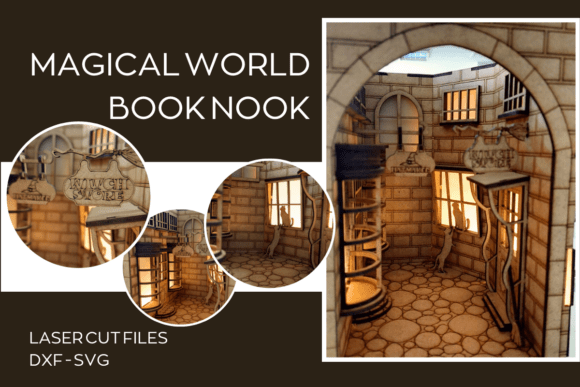
As a designer who’s stitched everything from boutique baby onesies to limited-run embroidered aprons for local cafés, I opened Book Nook Laser Cut Dxf-Svg expecting whimsy—and got something more useful: quiet storytelling with structural integrity. This isn’t just another “cute” digital file. It’s a miniature architectural sketch translated into cut-ready geometry—designed for laser cutting first, yes, but with surprising adaptability for embroidery when approached thoughtfully.
A Design That Breathes on Fabric
The first thing that struck me wasn’t the detail—it was the negative space. The Book Nook Laser Cut Dxf-Svg leans into clean outlines and intentional gaps: window frames, shelf edges, book spines—all defined by crisp silhouettes rather than dense fills. That makes it unusually friendly for embroidery reinterpretation. I sketched a quick mockup of it as a satin-stitched patch on a linen tea towel, and immediately saw how the open shapes would let the fabric breathe instead of drowning under heavy fill stitch.
This is where many designers misstep: assuming a laser-cut SVG must be converted literally. But this design’s strength lies in its restraint. The “nook” reads instantly—a cozy, contained vignette—so even simplified versions (say, running-stitch outlines on a cotton tote bag) retain charm and recognition. For Etsy sellers offering personalized nursery decor, that clarity matters. A new parent scrolling at 10 p.m. needs to *get* the idea in half a second.
Where It Shines (and Where It Asks for Care)
I tested a scaled-down version on a medium-weight cotton sweatshirt—hooped with tear-away stabilizer and stitched in soft matte rayon thread. At 3.2 inches wide, the window arch held crisp definition, and the tiny shelf brackets read cleanly. No puckering. No thread breaks. That’s a win for custom apparel and small shop merchandise.
But here’s the real talk: Book Nook Laser Cut Dxf-Svg doesn’t translate well to stretchy or ultra-thin fabrics without adjustment. On a lightweight baby onesie? I’d simplify the inner details entirely—swap fine shelf lines for bold outline + subtle fill, and skip the tiny book spines. On dark fabric, contrast becomes critical: light thread works, but only if stitch density stays moderate. Overly dense satin stitching on black twill can flatten the dimensionality this design relies on.
It also resists curved surfaces. I tried a cap front layout—no go. The horizontal shelf line warped visually on the dome. Better suited for flat, stable substrates: pillow covers, kitchen towels, embroidered patches, or framed hoop art for boutique branding.
Real-World Use Case: A Holiday Tote Bag Series
Last December, I used a modified interpretation of Book Nook Laser Cut Dxf-Svg for a small-batch holiday tote collection sold at a local makers’ market. We stitched it onto natural canvas totes (100% cotton, medium weight), using ecru thread and a balanced mix of satin and fill stitches. Customers didn’t just buy a bag—they bought a *vibe*: literary, calm, handmade. Several asked if we’d do matching tea towels or baby blankets. That’s the power of cohesive, mood-driven design assets.
What made it work? We kept the stitch count lean, avoided tiny lettering (the original includes no text—smart), and sized it to sit comfortably centered on the tote’s front panel—not crammed near the seam. That attention to placement and scale turned a digital embroidery file into a tactile, gift-ready finished product.
Design Judgment Notes Every Embroiderer Should Make
- Test on scrap first—especially if using textured fabric like terry cloth or bouclé. Those open windows can snag or distort.
- Check thread color contrast early. This design thrives on subtlety—but not invisibility. On heather grey, a pale oat thread vanished; switching to warm taupe brought it alive.
- Review stitch density. Original files may assume laser precision, not needle movement. Trim unnecessary travel stitches and lighten fill areas if converting to machine embroidery design.
- Confirm hoop size compatibility. Even scaled down, the full scene needs at least a 4×4 hoop. For caps or narrow items like wristbands, isolate one element—like just the arched window—as a standalone embroidered patch.
- Inspect small corners and junctions. Laser-cut files sometimes leave micro-gaps or overlapping vectors. Clean those before digitizing—or your satin stitch edges will feather unpredictably.
- Mock it in black and white. Does the shape still read clearly without color? It did for me—and that’s a sign of strong visual hierarchy.
- Use proper stabilizer. Medium-weight cutaway for knits, tear-away for stable wovens. Skipping this undermines the clean lines this design promises.
- Verify licensing. Since this lives in the Other Art Amp category and is labeled Laser Cutting, confirm whether commercial embroidery use is permitted—especially if selling finished products or digital embroidery files on Etsy.
Why It Builds Trust—Not Just Texture
In a sea of over-digitized, hyper-saturated embroidery files, Book Nook Laser Cut Dxf-Svg stands out by trusting the maker’s judgment. It doesn’t shout. It invites. That tone carries through to the customer: a hand-stitched pillow cover featuring this motif feels intentional, not algorithmic. It supports brand consistency for creative entrepreneurs who value quiet sophistication over trend-chasing.
And for holiday embroidery or personalized gifts? Its narrative warmth lands differently than generic florals or monograms. It suggests shared language—books, comfort, imagination. That emotional resonance lifts perceived value, encourages repeat buyers, and makes photos of your finished product more likely to stop a scroll.
If you’re evaluating Book Nook Laser Cut Dxf-Svg for your craft business, ask yourself: Does it support the story your brand tells? Can it live across multiple product types without feeling repetitive? Does it respect both the machine’s limits and the wearer’s experience? For me—the answer was yes. Not as a plug-and-play file, but as a thoughtful, adaptable foundation. One that stitches well, sells honestly, and feels like yours long after the hoop comes off.