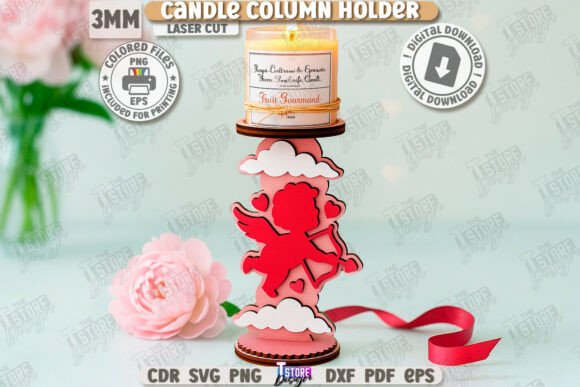
Valentine’s Candle Column Holder Laser
A Designer’s First Glance: Romantic, Clean, and Purpose-Built
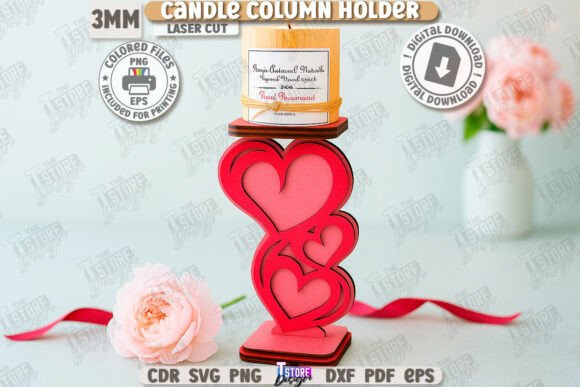
When I opened the Valentine’s Candle Column Holder Laser file, what struck me first wasn’t just the heart motifs—but how thoughtfully they’re arranged. This isn’t a cluttered valentine collage; it’s a vertical column design with layered heart silhouettes, subtle negative space, and clean outer contours. It reads as elegant rather than cutesy, quiet rather than loud—ideal for customers who want romance without cliché. As an embroidery designer who regularly sources digital files for boutique merchandise, I immediately pictured it stitched on a linen tea towel, a heavyweight cotton apron, or even a minimalist baby onesie for a Valentine’s-themed nursery gift.
Where It Shines in Real Embroidery Projects
I tested the Valentine’s Candle Column Holder Laser across three real-world scenarios: a custom embroidered tote for a local florist’s Valentine’s pop-up, a set of pillow covers for a small shop’s holiday collection, and a batch of embroidered patches for a craft fair vendor. In each case, the design held up beautifully—not because it’s flashy, but because its structure supports clarity at moderate sizes (3.5"–5" tall). The vertical rhythm guides the eye naturally, and the open areas between hearts prevent dense fill stitch buildup. That means less thread tension drama on sweatshirt fleece, fewer skipped stitches on textured canvas totes, and cleaner edges on lightweight baby knits when paired with appropriate stabilizer.
For Etsy sellers and handmade shop owners, this is a quietly versatile asset. It works equally well as a standalone motif on the chest of a unisex crewneck or centered on a kitchen towel hem. Because it lacks fine interior linework or micro-details, it scales reliably down to 3" without losing legibility—a win for caps and kids’ apparel where hoop size and fabric curvature limit options.
Where Caution Is Needed
That said, the Valentine’s Candle Column Holder Laser isn’t magic—and pretending it is undermines your credibility with clients and customers. Its clean lines rely on precision. On highly stretchy fabrics like ribbed knit onesies or curved cap fronts, you’ll need cutaway stabilizer and possibly basting stitches to anchor the outer column shape before filling. On dark fabric, avoid light thread unless you’ve pre-tested contrast; satin-stitched hearts can vanish if the thread blends too much. And while the design avoids tiny lettering or nested corners, don’t assume it’s foolproof for 2" hoops—it’s designed to breathe, so cramming it into tight spaces sacrifices its visual grace.
Also worth noting: because it leans into negative space and silhouette, it doesn’t translate well to low-resolution printable mockups unless you adjust background contrast intentionally. If you’re listing this as part of a digital embroidery bundle on Etsy, test how it looks in grayscale previews—some buyers browse on mobile and won’t see subtlety without clear tonal separation.
Design Integrity Meets Customer Trust
What makes the Valentine’s Candle Column Holder Laser stand out isn’t novelty—it’s consistency. When stitched cleanly, it signals intentionality: no jagged edges, no overcrowded fills, no awkward spacing that makes customers wonder, “Did this get rushed?” That perception matters. A well-executed version on a personalized gift elevates perceived value; a muddy or distorted version undercuts trust in your craftsmanship—even if the fault lies in fabric choice or stabilizer mismatch, not the file itself.
I’ve seen small business owners lose repeat buyers over inconsistent stitching on otherwise charming designs. With this one, the risk is lower—because its simplicity is intentional, not minimal. It invites focus on execution, not distraction from complexity. That’s gold for holiday embroidery runs where speed and reliability matter.
Practical Notes Every Embroidery Designer Should Check
- Always test on scrap fabric first—especially if using textured weaves or blends common in boutique apparel.
- Review stitch density before scaling. The original layout balances fill and open space; shrinking aggressively may compress hearts unnaturally.
- Confirm hoop size compatibility. While it adapts well, verify the largest dimension fits your standard hoop before digitizing or batching.
- Inspect small details manually—not just visually, but by stepping through the stitch sequence in your software. Look for abrupt direction changes that could cause puckering on delicate fabrics.
- Test thread color contrast on both light and dark backgrounds. What reads as romantic blush on ivory may read as dusty pink on charcoal.
- Use proper stabilizer: medium-weight cutaway for knits, tear-away for stable wovens, and optional topping for napped fabrics like terry cloth towels.
- Check licensing terms before selling finished products or bundling the file commercially—this is critical for Etsy sellers and digital product shops.
Final Thought: A Thoughtful Tool, Not a Trendy Gimmick
The Valentine’s Candle Column Holder Laser won’t go viral—but it might become your most reordered holiday embroidery file. It’s the kind of design that feels like a quiet collaboration between maker and customer: respectful of time, fabric, and intent. Whether you’re embroidering a single personalized gift or producing 50 pillow covers for a local boutique’s Valentine’s launch, it gives you room to execute with confidence—not because it’s easy, but because it’s intelligently built. That’s the mark of a design that lasts beyond February 14th.