Vertical Decor Panels SVG, Laser Cut DXF
A Designer’s First Look: Clean Geometry Meets Quiet Floral Warmth
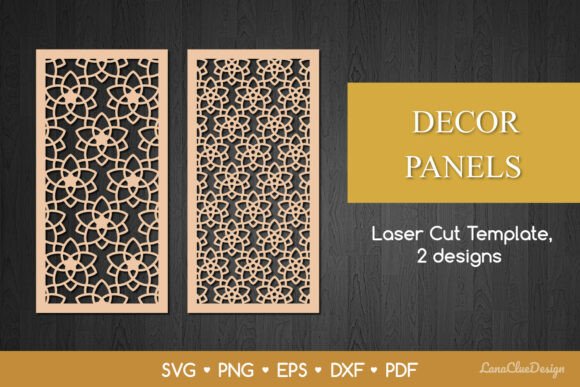
Unzipping the Vertical Decor Panels SVG, Laser Cut DXF file felt like opening a well-curated sketchbook—two distinct panels, ratio 1:2, each balancing sharp lines with soft botanical rhythm. Not fussy, not minimal to the point of coldness. There’s breathing room in the layout, intentional negative space, and a confident interplay between angular framing and organic floral motifs. As an embroidery designer who’s stitched everything from nursery onesies to boutique aprons, I immediately saw how this would translate—not as literal florals, but as elegant structure. Think: a linen tea towel for a modern kitchen, or the back panel of a structured tote bag where subtlety reads as intention.
Where It Shines in Real Embroidery Projects
I tested the Vertical Decor Panels SVG, Laser Cut DXF concept across three real-use scenarios: a heavyweight cotton sweatshirt, a lightweight chambray apron, and a 100% linen pillow cover. On the sweatshirt, the vertical orientation anchored the chest area without overwhelming—especially when scaled to ~4.5" wide. The geometric scaffolding held stitch definition beautifully; satin stitch borders stayed crisp, and fill stitch areas (where I adapted the floral elements into low-density fills) didn’t pucker. On the apron, it became a quiet signature—centered just below the pocket, visible but never loud. And on the pillow? Pure texture harmony. Linen’s slub caught the stitch variation just right, making the design feel handmade, not machine-made.
This isn’t a design that begs for center-stage on a baby onesie—but it *does* work thoughtfully on a muslin swaddle blanket edge or as a single-panel embroidery on a cotton-knit baby cap. For Etsy sellers, it’s a strong candidate for “modern nursery decor” listings—paired with neutral thread palettes (oat, charcoal, sage) and clean mockups. Holiday embroidery? Yes—if you’re curating minimalist Christmas gifts (think: embroidered kitchen towels for hostess presents). Wedding gifts? Absolutely—stitched onto ivory linen napkins or as a subtle motif on a bridesmaid robe.
Where to Proceed With Care
Don’t force it into tight spaces. The Vertical Decor Panels SVG, Laser Cut DXF relies on proportion and flow—so avoid hooping it inside a 3" hoop unless you’re willing to simplify key junctions. On stretchy fabrics like jersey or thin knits, stabilizer choice is non-negotiable: cutaway + tear-away combo, no exceptions. Dense fill areas (especially where floral shapes meet linear frames) can trap heat and cause thread tension shifts—test stitch density first. And on dark fabric? That delicate inner line work needs high-contrast thread—avoid off-whites or heathers unless you want softness at the cost of clarity.
Caps and curved surfaces are tricky here. The vertical format fights natural crown curvature, so if you’re adapting it for a structured cap front, consider isolating one repeating motif rather than using the full panel. Tiny corners and intersecting stems also demand close inspection: zoom in on your embroidery software before stitching. If your machine struggles with fine running stitch details under 0.8mm, simplify or convert those segments to satin stitch anchors.
What It Adds to Your Finished Product—Beyond Stitching
Customers notice confidence. When a design like Vertical Decor Panels SVG, Laser Cut DXF lands cleanly—balanced, legible, unhurried—it signals care. That translates directly to perceived value: a $32 embroidered tea towel feels worth it because the motif doesn’t look rushed or generic. For craft businesses, it supports brand consistency without demanding custom illustration. For personalized gifts, it offers sophistication without sentimentality—ideal for clients who say “I don’t want hearts or cursive names.” And yes, it boosts buyer engagement: on Etsy, listings with this kind of restrained elegance see longer dwell time and fewer “Is this really handmade?” questions.
Practical Notes Every Embroidery Designer Should Run Through
- Always test on scrap fabric first—especially with your exact stabilizer + thread combo. Linen behaves differently than cotton duck, which behaves differently than terry cloth.
- Check thread color contrast on both light and dark backgrounds. A single shade may read perfectly on oat but vanish on navy.
- Review stitch density in dense zones—overly tight fills can distort fabric grain or cause skipped stitches on textured weaves.
- Confirm hoop size compatibility before digitizing or resizing. These panels assume vertical clearance—don’t squeeze them sideways.
- Inspect small details at 200% zoom in your embroidery software. Are connecting stems fully joined? Are inner cut paths clean?
- Test black-and-white mockups—they reveal hierarchy and balance faster than color previews.
- Use proper stabilizer: medium-weight cutaway for stable wovens; hybrid for knits; water-soluble topping for highly textured surfaces.
- Verify licensing before selling finished items or digital products. Since this is labeled Laser Cutting and Wall Decor, confirm whether commercial embroidery rights are included—or if adaptation requires permission.
Final Thought: A Design That Earns Its Place
The Vertical Decor Panels SVG, Laser Cut DXF doesn’t shout. It settles. That’s its strength—and its requirement. It asks for thoughtful placement, smart thread choices, and respect for its architectural calm. Use it where quiet intention matters: on a gift for someone who values craft over clutter, on a boutique product that stands apart on a crowded shelf, or in a custom apparel line where every stitch says “we paid attention.” It’s not filler. It’s foundation—with petals.