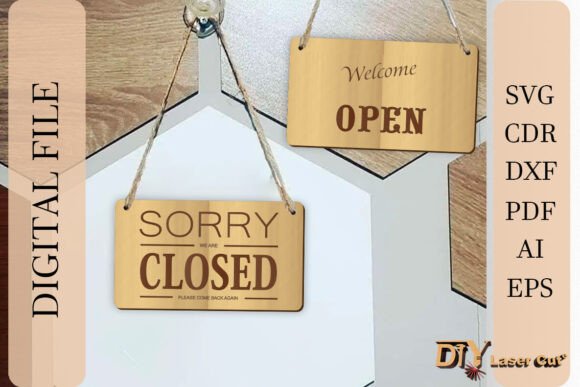
Reversible Open Closed Door Sign: Laser Cutting for Local Signs
As a brand designer who’s developed visual identities for 17 local businesses—from sourdough bakeries in Portland to zero-waste skincare studios in Asheville—I opened the Reversible Open Closed Door Sign file expecting utility. What I found was quiet intentionality: a three-layer laser-cut design that breathes calm authority and approachable warmth. It doesn’t shout—it invites. That subtle duality makes it unusually versatile for small business branding where tone matters as much as function.
A First Impression That Builds Trust Before the Door Opens
The moment you preview this graphic design asset, you sense its grounded elegance—clean lines, balanced negative space, and intentional weight distribution across both “Open” and “Closed” sides. It reads as handmade but precise, friendly but professional, and timeless rather than trendy. For a neighborhood florist launching seasonal pop-ups, or a ceramic studio adding branded signage to their studio door, this isn’t just a functional indicator—it’s a silent brand ambassador. It suggests care, consistency, and attention to detail—qualities customers subconsciously associate with reliability.
Where This Sign Design Earns Its Place in Real Business Branding
I recently used the Reversible Open Closed Door Sign as a core visual motif for “Hearth & Hive,” a small-batch candle brand operating out of a converted garage studio. We extended it beyond the door: scaled down for hang tags, mirrored into packaging accents on soy-wax boxes, and layered behind hand-lettered price lists at farmers’ markets. Here’s how it pulled real weight across touchpoints:
- Product labels: Used as a subtle foil stamp on kraft label stock—elegant without competing with scent names or burn instructions.
- Packaging design: Integrated into belly bands for gift sets, reinforcing “open to joy” messaging during holiday campaigns.
- Social media graphics: Animated the flip between “Open” and “Closed” for Instagram Stories—driving foot traffic during soft openings.
- Printable design: Printed on seeded paper for thank-you cards—“We’re open to gratitude” became a memorable line customers shared.
- Seasonal campaign visuals: Paired with autumnal palette overlays for a limited-edition pumpkin spice candle launch—adding narrative texture without clutter.
Why It Strengthens Local Business Presentation—Beyond the Obvious
This isn’t just a sign—it’s a visual anchor that lifts multiple aspects of small business branding at once. When applied thoughtfully, it delivers:
- Stronger first impression: Customers perceive intentionality before they even step inside—critical for boutique retail or appointment-based services like estheticians or barbers.
- Better product recognition: Repeating the same clean motif across packaging, stickers, and digital ads builds subconscious familiarity.
- Clearer visual hierarchy: Its balanced shape naturally draws the eye—ideal for directing attention on crowded market booths or minimalist web banners.
- More consistent brand identity: Works equally well alongside serif (for heritage feel), sans serif (for modern clarity), or soft script fonts (for handmade charm).
- Improved customer trust: The precision of laser cutting signals craftsmanship—aligning perfectly with handmade business values.
Best Fits: Where the Design Shines Most
The Reversible Open Closed Door Sign excels where authenticity and warmth intersect with polish. It’s ideal for:
- Product mockups—especially for food labels, soap wraps, or home goods where “handmade” meets “shelf-ready.”
- Hero graphics on Shopify banners or local event flyers—its symmetry commands attention without shouting.
- Decorative brand elements—think die-cut windows on greeting cards or embossed details on bakery boxes.
- Boutique visuals—used as a watermark on receipt tape or as a subtle pattern repeat in background textures.
- Social media campaign graphics—especially for “grand opening,” “seasonal hours,” or “we’re back” announcements.
Use With Intention—Not Every Space Needs a Door Sign
While versatile, this graphic design asset isn’t universal. Avoid placing it where clarity trumps charm:
- In formal corporate branding—its warmth can undercut serious B2B positioning.
- On very small labels (<5mm height)—fine details in the layered cut may not resolve cleanly in print.
- Within ingredient-heavy layouts—like USDA-compliant food packaging—where regulatory text must dominate.
- Against low-contrast backgrounds—test thoroughly in grayscale; some vector versions lose legibility without sufficient tonal separation.
- In luxury minimalist brands—where absence of ornamentation is the statement—this adds deliberate presence.
Practical Brand Designer Notes You’ll Actually Use
Before dropping the Reversible Open Closed Door Sign into your next project, do these six checks:
- Test it on real packaging mockups—not just digital previews—to assess scale, bleed, and material interaction (e.g., how it reads on matte vs. glossy stock).
- Check black-and-white usage: Does the outline hold up when reversed out of dark backgrounds? Some SVG exports need stroke adjustments.
- Preview it on small labels—zoom to actual print size. Confirm readability of “Open”/“Closed” at 8pt type equivalents.
- Test it with your brand colors: Layer it over your primary palette swatches. Does it harmonize—or compete?
- Compare it beside competitor packaging: Does it elevate your shelf appeal, or blend in?
- Verify commercial licensing: This is a digital product from a creative marketplace—confirm it permits physical product sales, client work, and resale in packaged goods before committing.
Whether you’re designing for a children’s toy shop revamping their storefront, a seasonal hot chocolate stand launching winter pop-ups, or a handmade soap brand building cohesive product mockups—the Reversible Open Closed Door Sign earns its place not as decoration, but as a strategic piece of your brand identity system. It’s proof that sometimes, the most effective design assets aren’t flashy—they’re thoughtful, reusable, and quietly confident. And for local business owners building real-world trust, one door at a time—that’s everything.