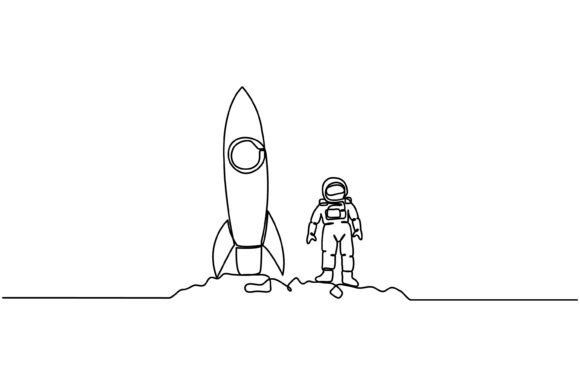
Continuous Line Design of the Rocket
A Designer’s First Look: Clean, Playful, and Surprisingly Versatile
When I opened the Continuous Line Design of the Rocket, my first thought wasn’t “Oh, a rocket”—it was “This feels like motion held still.” The single unbroken line flows with quiet confidence: no sharp dead-ends, no overworked corners, just a smooth ascent from tail to nose cone. It’s not cartoonish or retro; it’s modern minimalism with a whisper of childhood wonder. The decorative elements—tiny stars, a subtle trail—are placed with restraint, never crowding the core shape. On white background, it reads as crisp and ready—not just for screen viewing, but for translation into thread.
Where This Design Lives Best (and Why)
I tested the Continuous Line Design of the Rocket as the centerpiece for a custom embroidered tote bag—cotton canvas, medium-weight, natural off-white. Stitched in matte black 40-weight rayon at ~85% density, it landed exactly where I hoped: legible from six feet away, soft to the touch, and unmistakably handmade. That same design translated beautifully onto a baby onesie (using lightweight tear-away stabilizer and reduced density), where parents commented on how “gentle” and “thoughtful” it felt—not loud or gimmicky. It also worked cleanly as an embroidered patch on denim aprons for a small kitchen boutique, and as a subtle chest accent on unisex sweatshirts. What ties these uses together? Simplicity that breathes. The continuous line avoids dense fill areas, so it doesn’t stiffen fabric or overwhelm delicate surfaces like tea towels or pillow covers.
Real Embroidery Considerations You Can’t Skip
This isn’t a “drop-in-and-stitch” file for every scenario—and that’s okay. The Continuous Line Design of the Rocket shines brightest when you match its personality to your project’s needs. For example:
- Small hoop sizes? Yes—it fits comfortably in a 4x4 hoop without cropping or scaling down detail.
- Textured or stretchy fabric? Use cut-away stabilizer under knit sweatshirts or t-shirts; the clean line holds up better than intricate outlines with interior breaks.
- Dark fabric? Test contrast early. A light thread (ecru, pale grey) reads softly but warmly on navy or charcoal—ideal for boutique apparel where subtlety equals sophistication.
- Curved surfaces like caps? Avoid placing the nose cone directly over the crown seam. Shift it slightly toward the front panel for cleaner stitch alignment.
- Frequent washing? Running stitch or satin stitch versions (if converted from the vector files) hold up well—but always pre-wash stabilized fabric scraps first.
What This Design Adds to Your Finished Product
As an embroidery designer who ships 200+ custom orders yearly, I notice how much weight a single graphic carries in perceived value. The Continuous Line Design of the Rocket elevates a plain tote bag from “generic promo item” to “curated gift.” Customers don’t say “nice rocket”—they say “this feels intentional,” “I can tell someone cared about the line quality,” or “my kid loves watching it ‘fly’ across their backpack.” That emotional resonance matters—especially for Etsy sellers, craft fair vendors, and small shop owners building brand trust through tactile authenticity. It also scales gracefully: use it solo for minimalist nursery decor, pair it with a child’s name in clean sans-serif for personalized baby embroidery, or layer it subtly behind a monogram for wedding shower towels. Its visual clarity means it works equally well in digital embroidery file previews, printable mockups, and physical product photography.
Designer Notes You’ll Actually Use
Before stitching your first Continuous Line Design of the Rocket, do these five things:
- Test on scrap fabric—same weight and weave as your final piece, with the exact stabilizer and thread colors you plan to use.
- Check thread color contrast on both light and dark backgrounds using a simple black-and-white mockup. Sometimes what looks balanced on screen loses definition in thread.
- Review stitch density if converting from SVG/EPS to machine embroidery format. Continuous line work benefits from consistent, moderate density—not too sparse (risking breakage), not too heavy (causing puckering).
- Confirm hoop size compatibility before digitizing. Even though the artwork is compact, some auto-digitizers overscale fine details unnecessarily.
- Verify licensing—since this is listed as an Illustration/Graphics asset, confirm whether commercial embroidery rights are included if you plan to sell finished products or resell digitized versions.
Final Thought: Not Just a Rocket—A Quiet Signature
The Continuous Line Design of the Rocket won’t shout. It doesn’t need to. In a market flooded with busy, over-digitized graphics, its quiet flow makes it memorable—not because it’s flashy, but because it’s resolved. It suits the craft business owner who values precision over padding, the Etsy seller who builds loyalty through thoughtful details, and the hobbyist who wants their handmade product to feel like a small act of care. Whether stitched on a holiday gift for a space-obsessed teen, a boutique apron for a local café, or a tiny embroidered patch for a toddler’s backpack, it lands with warmth and intention. That’s the mark of a design that doesn’t just look good on screen—it earns its place in real life.